


CERTIFICATE COURSE IN CLINICAL & MOLECULAR MICROBIOLOGY
-
By Prof.(Dr.)Savinder Singh
- 09/Dec/2025
- 0 Students
Course Description
🔬 What is Clinical Microbiology?
Clinical Microbiology is the branch of medical science that integrates laboratory findings with patient care. Unlike laboratory-based diagnostic microbiology, which focuses solely on identifying pathogens, clinical microbiology also emphasizes:
-
Diagnostic Microbiology – detection and identification of infectious agents
-
Antimicrobial Stewardship – rational use of antibiotics to combat resistance
-
Hospital Infection Prevention & Control – strategies to reduce healthcare-associated infections
🧪 What is Molecular Microbiology?
Molecular Microbiology applies advanced molecular techniques to diagnose infectious diseases. It involves the detection of bacterial, viral, fungal, and parasitic infections using methods such as:
-
Polymerase Chain Reaction (PCR)
-
DNA Sequencing
-
Next-Generation Sequencing (NGS)
Because of their speed, sensitivity, and specificity, molecular microbiology techniques have become essential diagnostic tools in modern medical microbiology.
🎓 Who Should Apply for Certificate Course in Advancing Clinical and Molecular Microbiology?
This program is designed for medical microbiologists seeking to expand their expertise in stewardship, infection control, and molecular diagnostics.
Eligibility & Ideal Candidates:
-
Qualifications: MBBS plus MD/DNB in Microbiology
-
Academic Pathway: Candidates aiming for teaching positions in medical colleges should apply preferably after completing senior residency
-
Clinical Pathway: Candidates interested in non-teaching roles in private or corporate hospitals may apply immediately after MD/DNB in Microbiology
-
Career Stage: Suitable for postgraduates, senior residents, and mid-career professionals who wish to strengthen skills in:
-
Antimicrobial stewardship
-
Hospital infection control
-
Diagnostic stewardship
-
Molecular techniques in medical microbiology
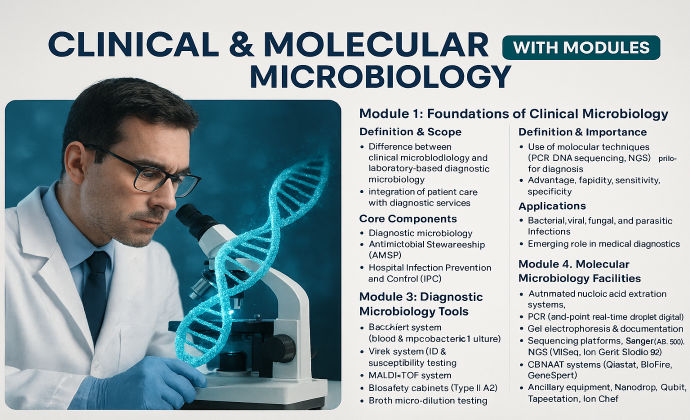
Module 1: Foundations of Clinical Microbiology-
Definition & Scope
-
Difference between clinical microbiology and laboratory-based diagnostic microbiology
-
Integration of patient care with diagnostic services
-
-
Core Components
-
Diagnostic Microbiology
-
Antimicrobial Stewardship (AMSP)
-
Hospital Infection Prevention and Control (IPC)
Module 2: Molecular Microbiology-
Definition & Importance
-
Use of molecular techniques (PCR, DNA sequencing, NGS) for diagnosis
-
Advantages: rapidity, sensitivity, specificity
-
-
Applications
-
Bacterial, viral, fungal, and parasitic infections
-
Emerging role in medical diagnostics
Module 3: Diagnostic Microbiology Tools-
BactAlert system (blood & mycobacterial culture)
-
Vitek system (ID & susceptibility testing)
-
MALDI-TOF system
-
Biosafety cabinets (Type II A2)
-
Broth micro-dilution testing (colistin, antifungal susceptibility)
-
Direct susceptibility testing from positive blood cultures
-
Microscopy (LED fluorescence, compound light)
-
Lyophilizer, -80°C & -20°C freezers
Module 4: Molecular Microbiology Facilities-
Automated nucleic acid extraction systems
-
PCR (end-point, real-time, droplet digital)
-
Gel electrophoresis & documentation
-
Sequencing platforms: Sanger (ABI 3500), NGS (MiSeq, Ion Gene Studio S5)
-
CBNAAT systems (Qiastat, BioFire, GeneXpert)
-
Ancillary equipment: Nanodrop, Qubit, Tapestation, Ion Chef
-
-
-
-
-
-
-
Course Curriculum
Prof.(Dr.)Savinder Singh
FounderEstablished this prestigious institute for development in education sector
₹500,000.00
Course includes:
-
 Level
Level
-
 Duration
2h
Duration
2h
-
 Lessons
0
Lessons
0
-
 Quizzes
0
Quizzes
0
-
 Certifications
Yes
Certifications
Yes
-
 Language
-
English